Etch Studio

One Builder. Multiple Platforms. Unlimited Possibilities.

Etch introduced WordPress to Era 4 development. Now it's time to plug Etch into the rest of the web.

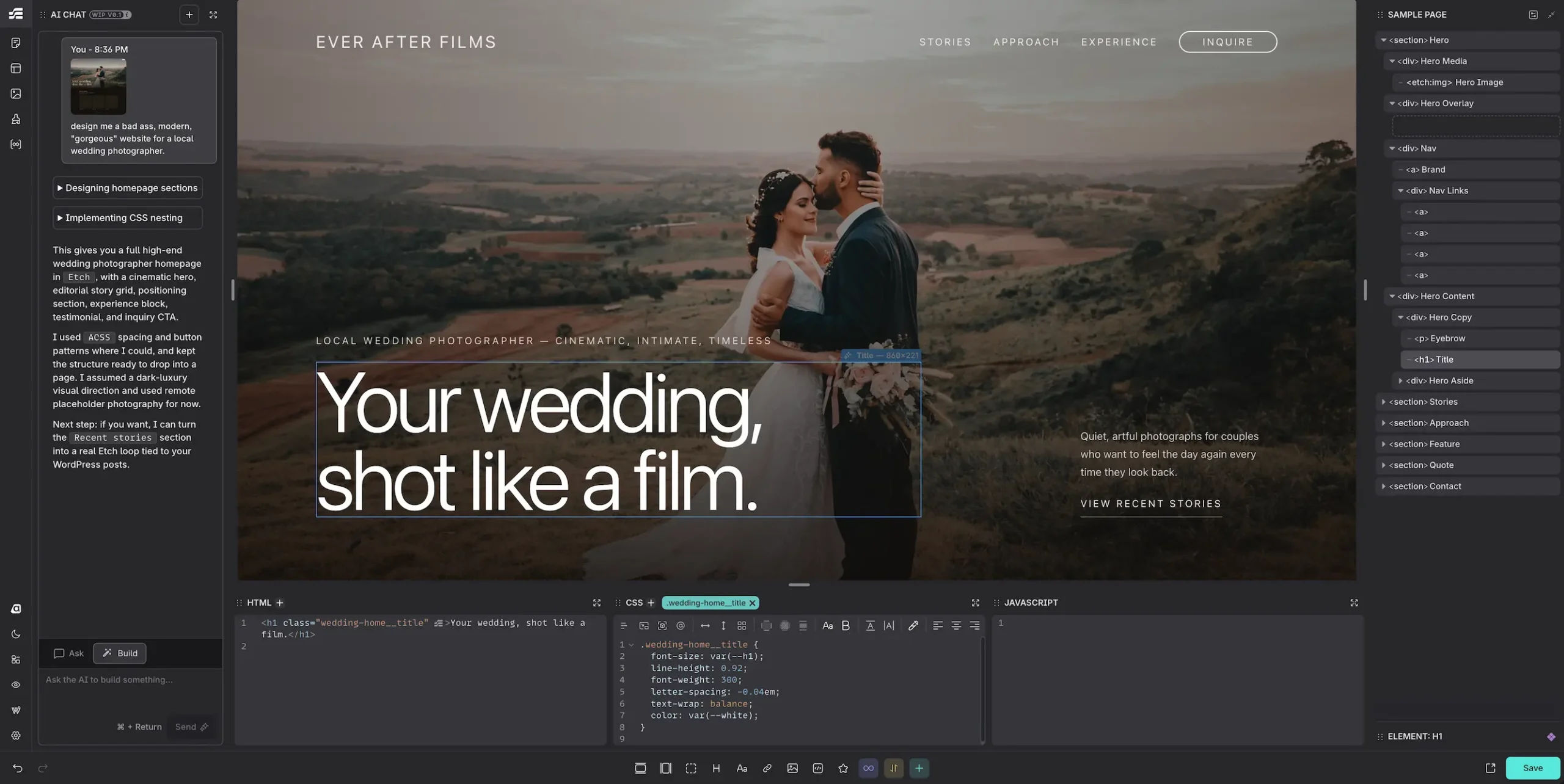
Etch interface with example website

Build With Prompts

Love AI? Describe what you want and watch it come to life. Etch is fully agentic and trained to be anti-slop.

Interact Visually

See everything in real-time, click new elements into existence, and edit directly on the canvas.

Code It Up

See and touch all the code. You can even write code from scratch if you love that life.

{#loop posts as post}
{author.name}
<Hero variant="dark" />
gap: var(--space-l);

Clean Code

Real Components

Loops & Logic

Dynamic Data

Isolated Code

Any Model, Any Harness

No Lock-In

Free Patterns

CPTs & Custom Fields

Asset Manager

Developer API

Fluid Responsive Canvas

Drag & Drop

Javascript Editor

Framework Agnostic

Clean Code

Real Components

Loops & Logic

Dynamic Data

Isolated Code

Any Model, Any Harness

No Lock-In

Free Patterns

CPTs & Custom Fields

Asset Manager

Developer API

Fluid Responsive Canvas

Drag & Drop

Javascript Editor

Framework Agnostic

The Vision

Etch is ... Diversifying.

Etch is expanding its vision (and for good reason). Here's what that means for existing users & future users.

Dear customers (and future customers),

We built Etch for WordPress because that is where most of you were building at the time. But what we actually created was a new way of working as a developer in general: visual when you want it, real HTML, CSS, and JS underneath, and nothing hidden from you.

The principles behind that have not shifted. Etch is a professional tool, designed and built to make professional, scalable, maintainable web development lightning fast. Clean output you would be proud to hand off with build speed that comes from the workflow itself, not from cutting corners.

Three things have changed, though: (1) Wordpress; (2) the way people prefer to work; (3) and the destinations people want to publish to.

WordPress first. Many of you have already left it, and you have told us why: leadership turmoil, public drama, recurring security problems, infrastructure that has not kept pace, and no real need for *most* projects. We understand. WordPress gave many of us our start and still runs a large share of the web, so we are not walking away from it. But it should be one option among several, not a condition of using Etch.

Then the work itself. Agentic development showed people something important: they no longer need to depend on WordPress and its plugin ecosystem to build serious sites. When an agent can build exactly what you describe, in a builder that visually abstracts & standardizes everything, you are in full command of the result. The archaic WordPress infrastructure stops being a necessary burden and becomes an optional one.

And finally, where the work ends up. A site today might live on a static host, a CDN, or an edge network, and increasingly it needs to publish to more than one of those. Developers want to pick the destination per project, or change it later, without changing how they build. A CMS that only knows how to publish to itself cannot offer that.

That's where Etch Studio comes in. It is the builder you already use, attached to a lightweight CMS system, that publishes static files to any destination (currently Cloudflare, with plans to expand). For the 80 to 85% of sites agencies and freelancers actually build (marketing sites, landing pages, portfolios, small content sites), Etch Studio can replace WordPress outright. It's all the stuff you need (content types, custom fields, relationships, loops, logic, and interactivity) with none of the baggage.

The principle behind this shift is simple: consistency in how you build, flexibility in where you publish. The same syntax, styling system, components, loops, and AI workflows behave identically whether the output lands in WordPress, Shopify, or on a static host. Learn Etch once and use it everywhere.

The choice is yours. If you need WordPress (its plugins, its ecosystem, a client who already lives there), use Etch for WordPress. If you do not need WordPress, use Etch Studio and skip the overhead. Same builder, same skills, different destination.

Thank you for building with us. Nothing you rely on today goes away. You simply have more places to take it. And, in the future, we hope to make it easy to migrate between the two platforms with just a few clicks so you never have to sweat about which route to take on any given project.

Kevin Geary, CEO
Digital Gravy
FAQs

Have Questions?

If you don't see your question answered here, please reach out in the Etch community. This site will be added to as we get closer to the public launch of Etch Studio.

EtchWP is absolutely not dead. WordPress is still a viable, popular, and important platform for building websites and is still a major "destination" for Etch. EtchWP is still in active development.

There could be a day where Etch Studio can publish directly to Shopify (as an example). But for now, Etch is capable of building e-commerce sites on WordPress. Many Etch users have built fantastic, fully-featured e-commerce sites. We still have plans to build our native Woocommerce integration, but there's nothing stopping you from building an e-commerce site in EtchWP today.

Yes. EtchWP customers are grandfathered in to a reduced rate on Etch Studio. You can currently sign up for Etch studio on this discounted rate via this post in the Etch community.

Etch Studio is the same Etch builder, just without WordPress. You work in the exact Etch workflow you already know. When you hit publish, Studio compiles your site into lightweight static files and pushes it live to Cloudflare, which is free to host. It has a light CMS built in (content types, dynamic data, loops, and logic), so you keep the dynamic side of Etch without a WordPress install behind the site. Cloudflare is the first publishing destination, and more are coming.

It's estimated that 8 out of 10 websites a typical agency builds can be built with Etch Studio. In fact, Etch Studio is likely the better fit. Most sites are brochure sites that don't change much, and they don't need WordPress' heavy architecture, updates, and hosting behind them.

This is true even if you build heavily dynamic sites with custom post types, dynamic data, loops, logic, and more. Studio has all of these features.

You really only need WordPress when a project depends on something WordPress-specific. That usually means the WordPress database, user login systems, or e-commerce through WooCommerce, SureCart, or a similar platform.

Note: Client editing isn't the deciding factor, since both platforms will support it.

Etch Studio isn't just software you install. We host the platform ourselves, so every Studio site comes with real ongoing hosting costs on our end. That's why Studio is billed monthly rather than as a one-time purchase, and why there won't be a lifetime deal for it.

Going forward, most new features will be built in Etch Studio first, because it's much faster to develop there. From there they're ported to Etch WP and adjusted to work with WordPress. We can't give an exact timeline for each port, because every feature is different.